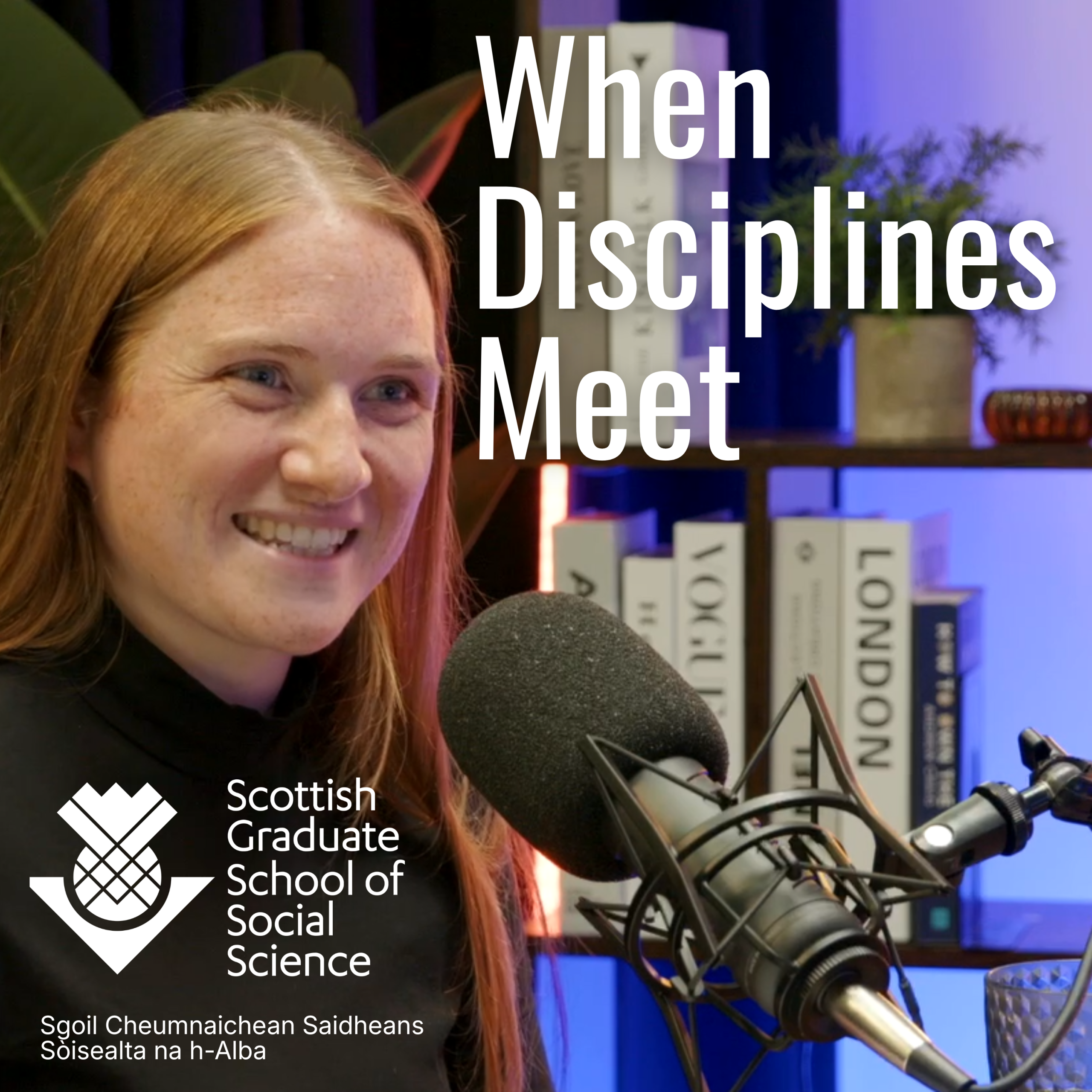
When Disciplines Meet is our new podcast series, exploring interdisciplinarity as it relates to the grand challenges that the social science research sector continues to contend with. Listen to our first five episodes, hosted by interdisciplinary researcher and Scottish Influencer of the Year 2024/25, Laura Anderson, and featuring guests from across the Scottish academic landscape.
Our host Laura talks to Dr Lisa Bradley, Professor John Holmwood and Dr Rachel Shanks about what disciplines are, and whether we still need them in a world where researchers are increasingly being asked to work across and between disciplines.
Lisa is an anti-disciplinary scholar and methodologist, with experience of working within and across the subject areas of Education, Urban Studies, Philosophy, Public Policy, Criminology and Sociology. Her work across these sites focuses on practices of knowledge production and meaning-making, and seeks to engage within the relationships between dominant knowledge structures, acts and practices, and marginalised ways of knowing and being, including within higher education.
John Holmwood is Professor Emeritus in the School of Sociology and Social Policy at the University of Nottingham and Senior Researcher in the Centre for Science Technology and Society Studies of the Institute for Philosophy at the Czech Academy of Science. He is the author (with Gurminder K. Bhambra) of Colonialism and Modern Social Theory (Polity 2021) and (with Jan Balon) of Empire and Subject Peoples: Herbert Adolphus Miller and the Political Sociology of Domination (Manchester University Press, 2025).
Rachel is the Interdisciplinary Institute Director for Social Inclusion and Cultural Diversity at the University of Aberdeen. After completing a law degree and Masters, she was a law lecturer, trade union organiser, employment rights adviser, and then did a funded PhD in Education. Currently her primary research interest is school clothing, in particular the affordability, comfort and sustainability of school uniform. She is co-editor of School Uniforms: New Materialist Perspectives (Springer, 2023) and editor of Teacher Preparation in Scotland (Emerald, 2020).
Our host Laura talks to PhD researchers Jivantika Satyarthi, João Magalhães and Blessing Bulaun about undertaking a social science PhD across multiple disciplines.
Jivantika Satyarthi is an architect and urban planner by training and has also been engaging with environmental psychology through her interdisciplinary PhD in Urban Studies at Heriot-Watt University. Her work explores how blue–green infrastructure can be designed to support both climate resilience and human wellbeing through nature-based soundscapes. Adopting a mixed methods approach to her research, Jivantika has used creative tools such as virtual reality environments of real-world neighbourhoods to test how the soundscapes generated by sustainable urban drainage systems (SuDS) influence residents’ restorative experiences.
Joao is a PhD candidate in Social Policy at the University of Edinburgh and a Public Health MD. Coming from health sciences, and as a medical doctor with a public health speciality working with communities, governments in the develop and developing world, has allowed him to get into political sciences with new perspectives.
Blessing is a PhD researcher at Robert Gordon University. Her work examines health communication strategies in addressing environmental sustainability, using qualitative and feminist methodologies. Engaging with disciplines beyond her own has significantly enriched her research approach, providing fresh insights and critical perspectives. Collaboration with scholars from different fields has taught her the importance of adaptability and openness, helping her to question established assumptions and methodologies within her discipline.
Our host Laura talks to Dr Catriona Connell, Moira MacKenzie and Dr Richard Lowrie about the challenge of drugs deaths in Scotland and how researchers can work across disciplines to improve outcomes.
Catriona works at the intersection of health and criminal justice, with a focus on the health and social circumstances of people involved in the justice system. She aims to contribute to better understanding peoples’ needs, their experiences of day to day life and accessing support, and how different approaches and solutions could make a difference to people.
Moira is the Deputy Chief Executive Officer/Director of Innovation of the Digital Health & Care Innovation Centre. She has over 30 years of experience in leading complex transformational change developments, enabled by digital within health, housing and care environments.
Moira led West Lothian Council’s ground-breaking Opening Doors for Older People Initiative, which inspired subsequent influential and high-profile roles including leadership of the Scottish Government’s National Telecare Development Programme and Head of Service for the high-achieving Scottish Centre for Telehealth & Telecare, which led the roll-out of Home & Mobile Health Monitoring, Telecare, computerised Cognitive Behavioural Therapy, and virtual consultations across Scotland.
Richard is a Reader in Homelessness and Inclusion Health at the University of Edinburgh, as well as Honorary Clinical Pharmacist Independent Prescriber (Homeless Outreach) for NHS Lothian, and Lead Pharmacist, Research and Development for NHS Greater Glasgow and Clyde.
Professor Mette High is a social anthropologist who is Director of the Centre for Energy Ethics at University of St Andrews and Director of the Scottish Research Alliance for Energy, Homes and Livelihoods. Both the Centre and the Alliance bring together researchers across disciplines and institutions, focused on not only what can be done but also what should be done to support an equitable and sustainable future. In her research on energy industries and global finance, she seeks to understand how people in the oil and gas industry make financial and ethical valuations of natural resources.
Ken is a Professor in Housing Economics at the University of Glasgow. He is an economist by background, and directs the UK Collaborative Centre for Housing Evidence; he was previously Director of Policy Scotland and What Works Scotland. His research focuses on the economic, financial and policy dimensions of housing (including economics and evaluation of net zero and lower carbon retrofit of existing housing).
Our host Laura talks to Professor Monika Harvey, Sabeehah Mahomed, and Dr Vassilis Galanos about Artificial Intelligence and how disciplines might look for the future of research.
Professor Monika Harvey is a Professor of Neuropsychology and Cognitive Neuroscience at the University of Glasgow. Her research interests fall in the area of cognitive neuroscience, with an emphasis on visual perception and the contribution of the two main cortical visual streams (dorsal and ventral) towards perception and action. She is working on using AI to predict brain age and cognitive impairment.
Sabeehah is a Research Associate at The Alan Turing Institute focusing on AI Ethics and Responsible Innovation. The British Academy has endorsed her work under the Global Talent category, and she was recognised on the 2025 International List of ‘100 Brilliant Women in AI Ethics’.
Dr Vassilis Galanos, SFHEA is Lecturer in Digital Work at Stirling Business School, the University of Stirling, exploring the history and sociology of artificial intelligence (AI) and the internet, and recently, the role of hype and metaphors in the technology’s development and adoption, as well as modes of resisting AI. Vassilis serves as Programme Director for BA (Hons) Business Studies at Stirling, Associate Editor for the journal Technology Analysis and Strategic Management, and together with James K. Stewart is the co-author of the book Internet, AI, and Society: A Textbook for the Perplexed (Wiley Blackwell, Inc.). Vassilis is also a photographer, DJ, Tarot reader, and has once jammed with the Sun Ra Arkestra.
Our host Laura talks to Dr Lisa Bradley, Professor John Holmwood and Dr Rachel Shanks about what disciplines are, and whether we still need them in a world where researchers are increasingly being asked to work interdisciplinarily.
Our host Laura talks to PhD researchers Jivantika Satyarthi, João Magalhães and Blessing Bulaun about undertaking a social science PhD across multiple disciplines.
Our host Laura talks to Dr Catriona Connell, Moira MacKenzie and Dr Richard Lowrie about the challenge of drugs deaths in Scotland and how researchers can work across disciplines to improve outcomes.
Our host Laura talks to Professor Monika Harvey, Sabeehah Mahomed, and Dr Vassilis Galanos about Artificial Intelligence and how disciplines might look for the future of research.